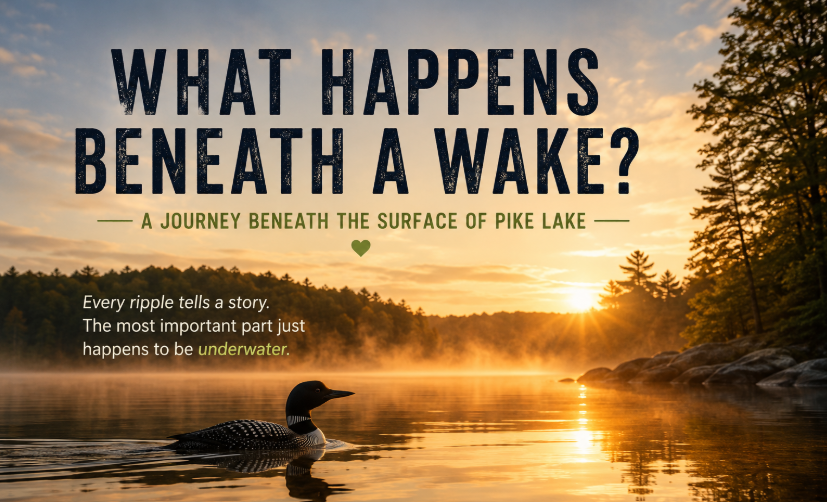
“Every ripple tells a story. The most important part just happens to be underwater in Pike Lake.”
Pike Lake Is Alive
It’s easy to think Pike Lake is simply… a lake.
A beautiful place to kayak.
A peaceful place to swim.
A favourite fishing spot.
A great excuse to tell your boss you’ll answer that email “after one more paddle.”
(We fully support this life choice.)
But Pike Lake isn’t just water.
It’s a living ecosystem.
Over half of the Pike Lake watershed—about 52%—is covered by forest, helping protect water quality and wildlife habitat. The watershed also includes approximately 20% wetlands and nearly 198 kilometres of connected streams and tributaries feeding into the system.
That’s not just impressive.
That’s extraordinary.
Pike Lake isn’t standing still.
It’s breathing.
Working.
Growing.
Every minute of every day.
Welcome to Pike Lake’s Underwater City
Most people only see the surface.
The real action happens underneath.
Picture an underwater city.
The aquatic plants?
Apartment buildings.
The fish?
Neighbours.
The turtles?
Retired folks enjoying the sunshine.
The insects?
Tiny delivery drivers working overtime.
Everything has a job.
Everything belongs.
Even the mud at the bottom is doing important work.
(It finally found a career after all.)

Then Along Comes a Wake
Most of us see waves.
Pike Lake feels something much bigger.
The shoreline absorbs energy.
Sediment begins to move.
Aquatic plants bend.
Young fish lose cover.
The underwater world suddenly becomes much busier.
Scientific reviews have found that wake-enhancing boats can generate larger, more energetic wakes than many conventional boats, with impacts extending well below the water’s surface.
It’s a bit like someone shaking your entire house…
…because they wanted to rearrange the furniture next door.

Pike Lake’s Invisible Forest
Nobody puts pondweed on postcards.
Nobody drives three hours to admire an exceptionally handsome patch of underwater vegetation.
Poor aquatic plants.
They have the worst marketing department in nature.
But here’s the funny part…
Without them…
Much of Pike Lake couldn’t function.
These underwater forests provide habitat for fish.
Produce oxygen.
Stabilize sediments.
Help keep water clearer.
Support insects.
Feed wildlife.
They’re basically the stage crew running the greatest show on the lake.
The actors get the applause.
The crew keeps everything from falling apart.
Meet Your Neighbours
The Common Loon.
The Painted Turtle.
The Merganser.
The Dragonfly.
The Bass.
The Pumpkinseed.
They don’t think Pike Lake is somewhere to visit.
They think it’s home.
And honestly…
They were here first.

“Not a visitor. A neighbor.”
The Domino Effect
Nature rarely shouts.
It whispers.
One change becomes another.
Clear water…
becomes suspended sediment.
Sediment…
covers aquatic plants.
Plants…
support fish.
Fish…
feed birds.
Birds…
raise families.
Everything is connected.
Pike Lake isn’t a collection of separate things.
It’s one incredible team.

A Day in The Life
Imagine you’re a tiny fish.

The Hitchhikers Nobody Invited
One fragment of invasive plant.
One zebra mussel.
A little water left inside ballast tanks.
Sometimes that’s all it takes.
Communities around Ontario have spent years trying to stop invasive species from spreading between lakes.
It’s a reminder that what leaves one lake doesn’t always stay there.
And what arrives somewhere new isn’t always welcome.
Unlike Uncle Dave.
Who still shows up every Thanksgiving.

Pike Lake Is Already Something Special
Here’s the good news.
Pike Lake has consistently earned a Very Good water quality rating.
That’s worth celebrating.
It’s also worth protecting.
Healthy lakes don’t happen by accident.
They’re the result of healthy forests.
Healthy wetlands.
Healthy shorelines.
Healthy communities.
And thousands of little decisions made by people who care.
The Real Luxury
People often think luxury is measured in horsepower.
Maybe.
But here’s another idea.
Luxury is hearing loons instead of traffic.
Luxury is watching mist rise off the water before sunrise.
Luxury is spotting your first bird in the morning.
Luxury is having a place where your brain finally stops trying to remember your passwords.
That’s the kind of wealth Pike Lake has always offered.
Full Send
Pike Lake doesn’t need superheroes.
It already has forests.
Wetlands.
Fish.
Loons.
Turtles.
Dragonflies.
And hundreds of people who love this place.
Sometimes protecting something extraordinary begins with something surprisingly simple.
Understanding it.
Because when you fall in love with an ecosystem…
Looking after it doesn’t feel like a sacrifice.
It feels like saying thank you.
❤️
Welcome to the Heart of Pike Lake.
📚 Research & Educational Resources
This article was inspired by our love for Pike Lake and informed by publicly available scientific research, conservation reports, and local watershed information. While portions of this article reflect our own observations and opinions about Pike Lake, we have relied on the following resources to better understand lake ecology, watershed health, shoreline stewardship, and the potential impacts of wake-enhanced boating.
We encourage readers to explore these resources and form their own conclusions.
🌊 Pike Lake & Watershed Information
Rideau Valley Conservation Authority (RVCA)
Pike Lake – Crosby Lake Catchment Report
The primary source for information about Pike Lake’s watershed, including water quality, wetlands, forests, tributaries, fisheries, and environmental health.
RVCA — Land Cover Report
Source for statistics referenced in this article, including:
- 52% Woodland
- 20% Wetlands
- Land cover analysis
RVCA — Pike Lake Accomplishments
A summary of decades of stewardship efforts by the Pike Lake Community Association and RVCA, including shoreline naturalization, tree planting, water quality monitoring, invasive species awareness, algae education, and habitat restoration.
Pike Lake Community Association
Information about Pike Lake stewardship, ongoing water quality monitoring, and actions residents can take to help keep the lake healthy.
https://www.pikelake.ca/general-4
🚤 Wake Boat Research
Wisconsin’s Green Fire
The Effects of Wake Boats on Lake Ecosystem Health (May 2024)
This literature review summarizes more than 175 scientific studies examining wake-enhanced boats, shoreline erosion, aquatic plants, sediment resuspension, fish habitat, invasive species, and boating safety.
🌿 Why This Matters
The scientific literature consistently shows that lakes are interconnected ecosystems. Healthy shorelines, aquatic vegetation, wetlands, fish habitat, and good water quality all work together to support both wildlife and people.
Pike Lake has earned a “Very Good” water quality rating in recent monitoring and benefits from extensive forest cover, wetlands, and a connected watershed. Those are qualities worth celebrating—and protecting.
❤️ Editorial Note
Project WakeSurf.com is an independent, community-driven educational website created by people who care deeply about Pike Lake. We are not affiliated with any government agency, conservation authority, or commercial organization.
The purpose of this article is to encourage respectful discussion about lake stewardship by combining scientific research, local watershed information, photography, and our own observations of Pike Lake.
Where we discuss Pike Lake specifically, we distinguish between:
- Established facts drawn from published research and watershed reports.
- Our opinions and observations about how those findings may relate to Pike Lake.
We encourage readers to review the original research, spend time on the lake, and continue learning about the remarkable ecosystem we all share.