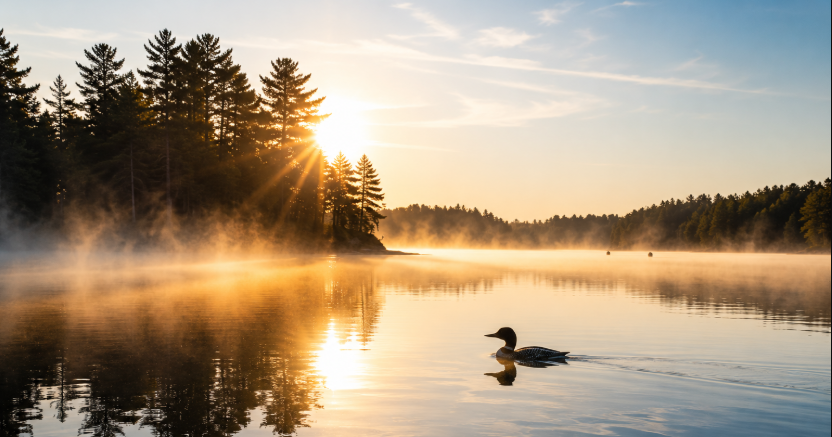
“The water heals in many different ways. For a few, it’s the thrill of surfing a wave. For others, it’s the peace of watching one disappear.”
Everyone Deserves a Place to Heal
Can a lake improve your mental health?
At Project Wake Surf, we believe it can.
Researchers have spent years studying the benefits of spending time in and around water. They often refer to lakes, rivers and oceans as “blue spaces,” and many studies have found they can help reduce stress, improve mood and strengthen our connection with nature.
We couldn’t agree more.
In fact, we believe that’s exactly why Pike Lake deserves thoughtful stewardship.
Because while people experience the lake in different ways, everyone deserves the chance to leave feeling a little lighter than when they arrived.
Project Wake Surf and Mental Health. The Water Doesn’t Judge
Nature has never cared how much money you have.
A sunrise costs the same for everyone.
So does a loon calling across calm water.
So does watching a painted turtle bask on a log.
Some people experience Pike Lake behind the wheel of a wake boat.
Others find the same peace in a used kayak they picked up on Facebook Marketplace.
Or a canoe that’s been in the family for twenty years.
Or simply swimming quietly along Pike Lake’s beautiful rocky shoreline.
The lake doesn’t judge.
And neither should we.
Because mental wellness shouldn’t have an admission fee.

The Water Heals in Different Ways
Some people recharge with excitement.
Others recharge with silence.
Some people leave the lake smiling because they caught the perfect wave.
Others leave smiling because they watched a family of of loons paddle across water so calm it looked like glass.
Neither experience is wrong.
The water heals in many different ways.
For some, it’s the thrill of riding a wave.
For others, it’s the peace of watching one disappear.
The Quiet We Sometimes Forget
When people talk about protecting lakes, they often talk about shoreline erosion, wildlife habitat and boating safety.
Those conversations matter.
However, there is another value that’s much harder to measure.
Quiet.
For many people, Pike Lake isn’t simply a place to visit.
It’s where anxiety slows down.
Where difficult weeks begin to make sense.
Where kids discover nature.
Where grandparents teach grandchildren to fish.
Where photographers wait patiently for loons.
Where neighbours enjoy a coffee before work.
Sometimes the goal isn’t catching a fish.
Sometimes the goal is simply catching your breath.
A Thought Worth Sitting With
If we truly believe time on the water improves mental health…
Shouldn’t we also protect everyone else’s opportunity to experience it?
The kayaker doesn’t paddle into a bird watcher’s perfect moment just to scare wildlife away.
The photographer doesn’t deliberately disturb someone fishing.
The kayaker doesn’t interrupt someone else’s peaceful morning just because they can.
In fact, most people enjoying quiet recreation naturally try not to interrupt one another.
Perhaps that’s one of nature’s unwritten rules.
Respect travels further than any wake.
Pike Lake Is Different
Pike Lake isn’t an endless stretch of open water.
It’s a smaller lake with narrow sections, rocky shorelines, quiet bays and beautiful places where people naturally gather close to shore.
That’s where many people paddle.
That’s where many people swim.
That’s where people learn to kayak.
That’s where wildlife raises its young.
That’s where many of us find the calm we’ve been looking for.
Every lake has its own personality.
We think Pike Lake’s greatest gift has always been its peaceful one.

The Cheapest Therapy You’ll Ever Find
Some people meditate.
Some keep journals.
Some talk to therapists.
Others buy a $200 used kayak…
…and accidentally discover the cheapest counselling session they’ve ever had.
A calm paddle before work.
An evening swim.
A quiet walk along the shoreline.
Watching turtles do absolutely nothing for twenty minutes.
Oddly enough…
It works.
(Scientific disclaimer: The turtle has not yet agreed to peer review this article.)
Coffee, Calm & Common Sense
Anyone who’s had their kayak unexpectedly transformed into a mechanical bull by a large wake knows…
Inner peace can disappear surprisingly quickly.
The same is true for coffee.
Morning coffee belongs in mugs.
Not in your lap.
Although Pike Lake has certainly tested that theory a few times.

The Heart of Pike Lake
Around here…
Cool looks a little different.
It looks like helping your neighbor.
Being considerate of others.
Hosting friends.
Sharing wildlife photos.
Swimming by the dock.
Leaving the shoreline a little better than you found it.
Anyone can buy horsepower.
Character is earned.
Maybe That’s the Real Luxury
Luxury isn’t always measured in horsepower.
Sometimes it’s measured in silence.
In hearing frogs instead of engines.
In watching loons instead of waves.
In finishing your coffee without it attempting waterskiing lessons.
In finding one place where your mind finally slows down.
Perhaps that’s the greatest gift Pike Lake has to offer.
Find Peace in the Silence
At Project Wake Surf, we believe every person deserves the chance to experience the healing power of nature.
Whether that’s from a kayak…
A canoe…
A fishing rod…
A camera…
A paddleboard…
Or simply sitting quietly on a dock at sunset.
Because the lake heals in many different ways.
If we truly believe spending time on the water improves mental health…
Then perhaps one of the kindest things we can do is protect someone else’s chance to experience that same feeling.
After all…
The coolest people aren’t always the loudest.
They’re the ones who leave the smallest footprint.
❤️
Welcome to The Heart of Pike Lake.
📚 Sources & Further Reading – Project Wake Surf and Mental Health
The ideas in this article are supported by a growing body of research examining the relationship between nature, “blue spaces” (lakes, rivers and oceans), physical activity and mental well-being.
Project Wake Surf and Mental Health Editorial Note
At the time this article was written, we were unable to identify peer-reviewed research demonstrating that recreational wakesurfing provides greater mental health benefits than other peaceful water-based activities such as kayaking, canoeing, swimming, fishing, wildlife observation or simply spending time beside a lake. Our review of the available literature found that most published research focuses on the broader benefits of blue spaces, spending time in nature, and water-based recreation in general, rather than concluding that one specific recreational activity is superior to another.
1. World Health Organization (WHO)
Green and Blue Spaces and Mental Health: New Evidence and Perspectives for Action
This WHO report summarizes systematic reviews on how access to green and blue spaces supports mental health, while noting that evidence does not identify a single “best” type of blue space or activity for everyone.
https://www.who.int/europe/publications/i/item/9789289055666
2. National Institute for Health and Care Research (NIHR)
Green and Blue Space and Mental Health
A comprehensive review examining how exposure to lakes, rivers, oceans and other natural environments is associated with stress reduction, psychological restoration and improved well-being.
https://www.ncbi.nlm.nih.gov/books/NBK597114
3. Systematic Review
Mental Health Benefits of Long-Term Exposure to Residential Green and Blue Spaces
Gascon M. et al.
International Journal of Environmental Research and Public Health (2015)
A systematic review of 28 studies examining long-term exposure to green and blue spaces and mental health. The authors conclude that more research is needed, but the overall evidence supports benefits associated with natural environments.
https://www.mdpi.com/1660-4601/12/4/4354
4. National Geographic
Nature Really Is Good Medicine. Science Can Explain Why.
A well-researched summary explaining how time spent around lakes, rivers and other natural environments supports mental health and well-being, drawing on WHO findings and other published research.
5. The Washington Post
Here’s How to Embrace the Benefits of “Blue Health”
A practical overview of the growing research into “blue spaces,” including lakes, rivers and oceans, and how they may reduce stress, improve mood and promote restoration.
https://www.washingtonpost.com/wellness/2025/07/29/blue-spaces-calming
6. Surf Therapy Research
Surf therapy is an emerging area of research exploring how surfing programs may support mental health for some participants. The research focuses primarily on structured surf therapy rather than recreational boating or wakesurfing.
https://en.wikipedia.org/wiki/Surf_therapy